Osteopathy, Physiotherapy & Wellbeing in Leeds
Expert practitioners providing personalised, evidence-based care to help you feel your best.
Good Health in Good Hands
You can trust that you’re in good hands with all our experienced, registered practitioners and that you’re one step closer to good health outcomes when you walk through our front door.
Diverse breadth of healing disciplines
Experienced, registered practitioners
Welcoming, accessible facilities
Served our community since 1993
Convenient booking
and same-day availability
Integrated, multi-disciplinary approach
Serving our community for over 30 years
Unique patients treated
Appointments serviced to date
Practitioners providing excellent care
Years of combined clinical experience
Excellent patient reviews
Serving our community for over 30 years
Unique patients treated
Appointments serviced to date
Practitioners providing excellent care
Years of combined clinical experience
Excellent patient reviews
Our practitioners have expertise spanning a variety of treatment disciplines
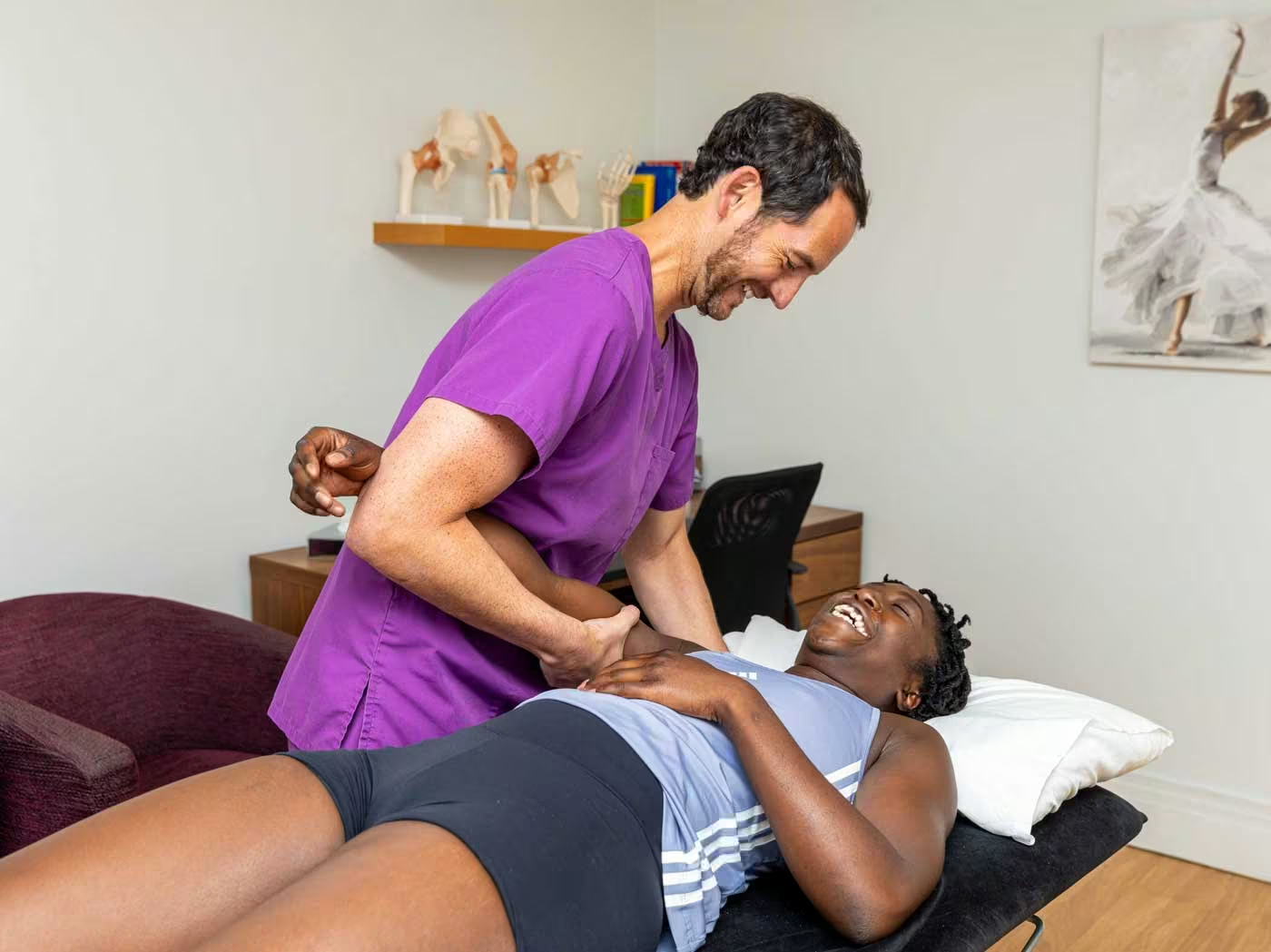
We treat a variety of conditions
We take an integrated approach to healthcare
We take a holistic, whole-body approach, looking at how different parts of the body affect each other, to identify and treat the root cause of the issue you’re facing. Our highly qualified practitioners work together as a multi-disciplinary team, providing you with a truly integrated treatment plan.
Our approach
- Listen: We dedicate time at the beginning of your treatment journey and at every appointment to better understand you and your health concerns
- Assess: We use a variety of clinical tests and conduct a comprehensive assessment to understand the root-cause of the issue you’re facing
- Diagnose: We share and explain our findings, along with the potential outcomes of treatment options
- Plan: We develop a personalised treatment plan just for you that may include complementary therapies available at our multi-disciplinary clinic
- Treat: We will treat with care, guiding you every step of the way
Trusted by Our Leeds Community
EXCELLENTTrustindex verifies that the original source of the review is Google. Recommended by a friend, and my own experience has only been positive. My first visit for osteopathy and Ben Harrison-Place took time to listen, to fully understand the issues I was having by taking an holistic approach and responding with an effective treatment plan. Recommend highly and wouldn’t hesitate to book in with Ben again if needed.Posted on GoogleTrustindex verifies that the original source of the review is Google. I recently had my initial ACL consultation with Gavin, and I was impressed with the level of care and professionalism he provided. Prior to the appointment, he requested a copy of my MRI report, and I brought the MRI images to our consultation. Gavin made me feel at ease and took the time to clearly explain what was happening with my knee, what to expect during recovery, and the steps we’d take moving forward. As someone who has also experienced an ACL injury, it was reassuring when he shared his own recovery from the injury. His knowledge as a senior Physiotherapist is evident, but what stood out was his ability to translate that expertise into practical guidance I could understand and act on. He listened carefully, answered each question thoroughly. Gavin’s approach is calm, reassuring, and genuinely patient‑focused. I walked away with a clear plan, a better understanding of my injury, and confidence that I’m in very capable hands. Highly recommended for anyone needing physiotherapy support, especially for ACL‑related issues.Posted on GoogleTrustindex verifies that the original source of the review is Google. Got an appointment the next day. Friendly ladies at the front desk. I had Gavin the Senior Physiotherapist for 45 minutes, looking into a shoulder injury I had. Made me feel very at ease, chatting about life but also explained what he was doing and what he was finding with my shoulder in easy to understand terms. Following the session he asked if there were any more questions and was happy to answer them. He then sent a detailed letter through within a couple hours at my request so that my employer could understand what in Gavin’s professional judgement was the way forward. Very pleased with the session and would return in a heartbeat if any injuries persist. Thank you!Posted on GoogleTrustindex verifies that the original source of the review is Google. I have been going to the good health centre for many years, most members of my family have attended for treatments at different stages too. I have seen various consultants, Ami, Doug, Richard, Tim, Louise, Josh and now Daniel. They are all fantastic in their own field and mostly my treatments have been homeopathy based. I know if I have a problem or an injury I can come and get some kind of ease to help with my recovery. They are very professional, they are empathetic , good listeners, warm and always explain what’s happening and what the next step of treatment will look like.. I’ve always had a warm and engaging welcome from the reception staff who try their utmost to accommodate your appointments best for you. A great team of people doing an amazing job with amazing skills. Where would we be with out these special people??.Totally satisfied.Posted on GoogleTrustindex verifies that the original source of the review is Google. I have seen Ben Harrison Place several times for Osteopathy treatment. He is extremely knowledgeable and personable. I have no hesitation in recommending him.Posted on GoogleTrustindex verifies that the original source of the review is Google. I’ve been seeing Emily for a couple of years, initially for neck pain. As my neck pain improved Emily also started to treat my long standing backpain/sciatica and hip bursitis. I am amazed by the improvements and am now almost pain free. Emily is caring and professional and a very skilled osteopath, and I have no hesitation in recommending herPosted on GoogleTrustindex verifies that the original source of the review is Google. I had pain in several places - ankle, hips, knees - and had been walking with a bit of limp. I saw Ben Harrison who carried out a very careful and thorough diagnostic process and told me that what I had thought for years was caused by sciatica probably wasn't. After the first session I immediately felt the difference and after three visits, and doing the exercises I was given, was mostly pain free and have continued to be so.Posted on GoogleTrustindex verifies that the original source of the review is Google. I have attended Good Health Centre for various ailments over several years . Recently I have been struggling with neck and knee pain as well as tennis elbow . Daniel Bowen has been treating me with a range of therapies including osteopathy , dry needling and shock wave therapy - the latter being particularly effective for my elbow . I have always found the practitioners here to be attentive , thorough and empathetic and Daniel has only reinforced this impression .Posted on GoogleTrustindex verifies that the original source of the review is Google. A massive thank you to Harriet. I’ve been seeing her for a couple years, and I’ve just bruised my coccyx recently. She was very good in helping to relive the tension from that area, and very supportive with making sure I was okay, and definitely helped to remove some of the pain I was feeling. 100% will visit again.Posted on GoogleTrustindex verifies that the original source of the review is Google. I have had treatment from Daniel Bowen at the Good Health Centre, for long standing back pain with the use of osteopathy and dry needling & and also knee pain (diagnosed with arthritis in my knee via NHS consultant cap via x-ray and MRI scan) and Daniel has used osteopathy and shockwave therapy which has taken the pain away and allowed me to continue to walk pain free for a few months at a time. Daniel has always been welcoming and supportive ! I highly recommend Daniel and the team at the Good Health Centre.Verified by TrustindexTrustindex verified badge is the Universal Symbol of Trust. Only the greatest companies can get the verified badge who has a review score above 4.5, based on customer reviews over the past 12 months. Read more
Why choose us?
- Fully qualified and registered osteopaths, physiotherapists, and other experienced practitioners
- Diverse breadth of healing disciplines across 20+ practitioners
- Integrated, multi-disciplinary treatment protocol, all under one roof
- Over three decades of experience at our Leeds-based clinic
- Welcoming and accessible facilities fit for all patients
- Convenient booking with availability on weekdays and Saturdays, allowing for prompt delivery of treatment